

Key Retail Theft Statistics Every Retailer Should Know
Insights Article
Posted: July 27, 2026
Retail Theft (Shoplifting) Statistics
Updated: July 2026
Retail theft continues to be a growing challenge for retailers across the United States. Research from Capital One Shopping highlights how shoplifting, organized retail crime (ORC), and return fraud contribute to billions in losses each year while forcing retailers to rethink traditional loss-prevention strategies.
As theft incidents increase in both frequency and sophistication, retailers are under pressure to adopt more effective, scalable solutions to protect merchandise while maintaining a safe and welcoming shopping environment.
Key Retail Theft Statistics Every Retailer Should Know
Retail theft continues to evolve across the United States, impacting retailers of all sizes. The following statistics highlight the scale of the challenge and explain why many retailers are investing in new loss-prevention strategies.
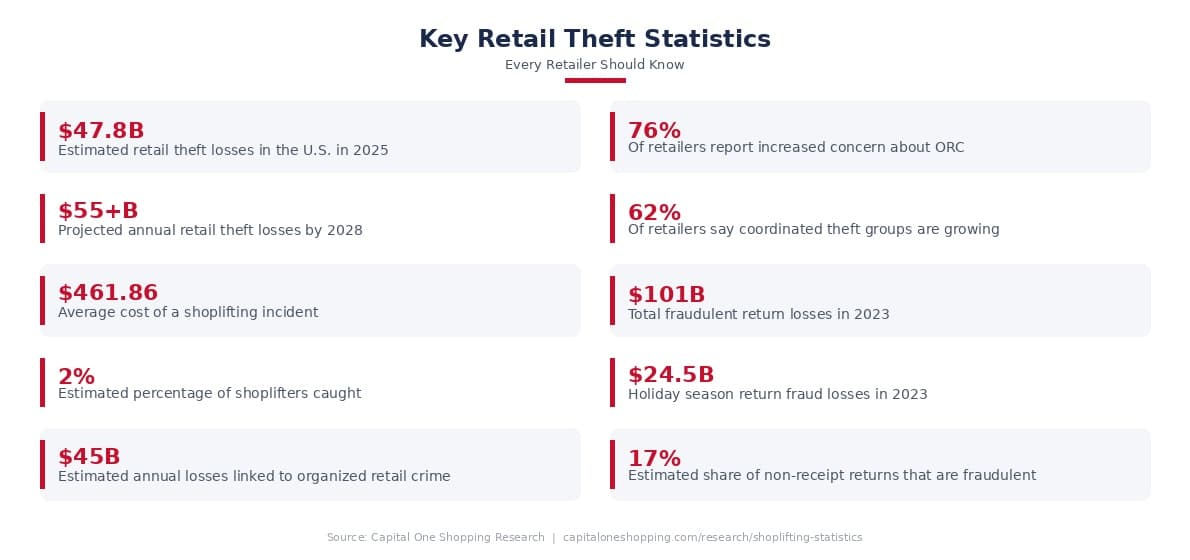
These numbers illustrate how retail theft has become a complex and organized problem rather than isolated incidents of opportunistic shoplifting. As a result, many retailers are shifting toward technology-driven prevention strategies designed to stop theft before merchandise leaves the store while improving visibility into repeat-offender activity.
Source: https://capitaloneshopping.com/research/shoplifting-statistics/
The Scale of Retail Theft
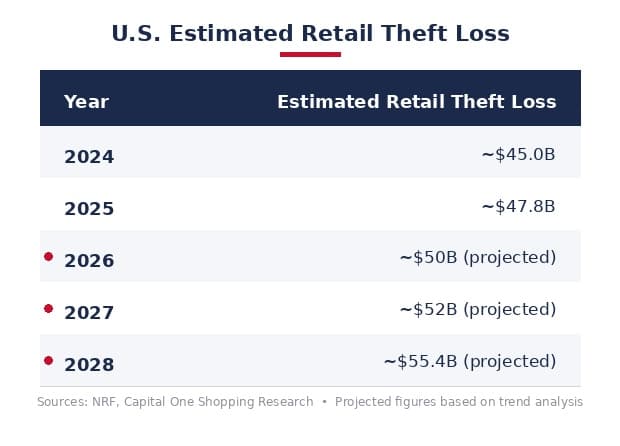
According to the latest analysis from Capital One Shopping, retailers lost $47.8 billion to theft in 2025, with projections suggesting total losses could exceed $55 billion annually by 2028 if current trends continue.
Shoplifting incidents have risen sharply in recent years. In 2023, there were 1.15 million reported cases of shoplifting nationwide — the highest rate since 2019 — representing a 26% increase over 2022 and a 93% increase over 2019.
The data also shows that:
- The average shoplifting incident costs retailers about $461.86
- Retailers only catch shoplifters approximately 2% of the time
- The average shoplifter is arrested once out of every 100 incidents
This extremely low arrest rate highlights the limitations of traditional loss prevention approaches that rely primarily on employee intervention or post-incident investigations.
Retail Theft Trends and Projections
Retail theft losses have steadily increased in recent years as organized retail crime networks expand, and new theft methods emerge. Industry data suggest these losses may continue to grow over the next several years if prevention strategies do not evolve.
Several factors are contributing to the growth in retail theft:
- Increased activity from organized retail crime groups
- Expansion of online resale marketplaces
- High-value pushout theft incidents targeting grocery and big-box retailers
- Repeat offenders targeting multiple locations
As a result, retailers are shifting their focus toward preventing theft before merchandise exits the store, rather than relying solely on investigation and recovery.
Organized Retail Crime on the Rise
Organized retail crime continues to escalate as criminal groups become more coordinated and sophisticated. These groups often target multiple stores in a region, stealing large quantities of merchandise that are later resold through online marketplaces or secondary retail channels.
Recent findings indicate that:
- Retailers lose approximately $45 billion annually to organized retail crime
- 76% of retailers report increasing concern about ORC
- 62% say coordinated groups stealing together is a growing problem
- Among retailers able to track ORC, incidents increased by 57% between 2022 and 2023
- 94% of surveyed retailers agree that federal legislation is needed to combat ORC effectively
These trends are reshaping how retailers approach loss prevention. Instead of focusing solely on investigation and recovery after theft occurs, many organizations are shifting toward prevention strategies designed to stop merchandise from leaving the store in the first place.
The Impact of Return Fraud
Retail theft is not limited to shoplifting. Fraudulent returns have also become a significant contributor to losses.
Research shows:
- Retailers lost $101 billion to fraudulent returns in 2023
- Return fraud represents approximately 13.7% of all retail merchandise returns
- $24.5 billion in holiday return fraud occurred in 2023 alone, representing 24.3% of all annual fraudulent returns
- 17% of returns without a receipt are estimated to be fraudulent
- The most common form of return fraud is wardrobing — returning used, non-defective merchandise — affecting 48.8% of retailers in 2023
- 57% of retailers were more concerned about return fraud in 2023 than in 2022
These schemes often involve the return of stolen merchandise for cash or store credit, creating an additional financial impact on retailers.
Why Retailers Are Rethinking Loss Prevention
These statistics illustrate how retail theft has evolved beyond isolated incidents of shoplifting. Retailers today face a combination of challenges, including:
- Organized retail crime networks
- High-value pushout theft incidents
- Fraudulent returns and refund abuse
- Repeat offenders targeting multiple locations
Traditional deterrence methods such as guards, gates, and post-event investigations can create visible security but may not consistently prevent theft.
Increasingly, retailers are adopting technology-driven loss-prevention strategies that provide real-time interventions and actionable data. By combining automation, video insights, and behavior-based detection, these systems help retailers prevent theft events before merchandise leaves the store.
The Role of Technology in Preventing Pushout Theft with Purchek
Retailers are increasingly deploying cart-based loss-prevention technologies that deter cart theft without confrontation. These systems intervene automatically when unpaid merchandise attempts to exit a store in a shopping cart.
Solutions such as Purchek technology from Gatekeeper Systems provide retailers with a scalable way to prevent cart-based theft while maintaining a positive shopping experience for paying customers.
By stopping the cart rather than confronting the individual, these technologies help retailers:
- Prevent merchandise loss before it leaves the store
- Reduce confrontation and safety risks for employees
- Gain insights into repeat offenders and theft patterns
- Measure ROI through actionable data and reporting
Strengthening Investigations and Awareness with FaceFirst
While prevention technologies like Purchek help prevent merchandise from leaving the store, retailers are also turning to intelligent investigation tools to better understand repeat-offender behavior and theft patterns.
FaceFirst, AI-enabled face matching software with human oversight, helps loss prevention teams identify known offenders and connect incidents across multiple locations. By providing investigative insights and alerts, this technology helps retailers move from reactive case building to more proactive decision-making.
When deployed responsibly and in compliance with privacy regulations, face-matching technology can support investigators by improving situational awareness and helping retailers identify repeat offenders who may target multiple stores.
A Layered Loss Prevention Ecosystem
As retail theft continues to evolve, many organizations are adopting layered loss prevention strategies that combine prevention, intelligence, and operational visibility.
Together, solutions such as Purchek pushout theft prevention and FaceFirst AI-powered face matching solution create a stronger loss prevention ecosystem. By preventing cart-based theft at the exit and helping retailers identify repeat offenders and activity patterns, retailers can better protect their people, products, and profits while maintaining an open and positive shopping environment.
For more detailed statistics and analysis, read the full report: https://capitaloneshopping.com/research/shoplifting-statistics/
About Gatekeeper
Gatekeeper Systems’ expanded product suite of intelligent cart and loss prevention solutions — including FaceFirst face matching software, offers solutions for EVERY retailer’s needs to minimize merchandise loss, reduce asset and labor expenditures.
Gatekeeper’s loss prevention and cart containment solutions utilize patented locking technology to put an end to cart-based shoplifting, shopping cart loss, and uninformed decision-making. Cart management solutions increase safety and reduce labor costs by maximizing productivity while simultaneously resulting in a positive store image.
Intelligent pushout theft prevention solutions stop thieves and their cart full of unpaid merchandise from leaving the store. Customizable technology allows retailers to defend their entire store or just a high-loss department based on the store’s unique layout.
Gatekeeper Systems’ FaceFirst face matching software identifies known offenders and persons of interest in real time, empowering store teams to proactively address threats before losses occur. This advanced AI-powered solution integrates seamlessly with existing security infrastructure to enhance safety for associates and customers alike.
Business Intelligence solutions provide increased visibility for informed decision-making. Increase efficiency, optimize fleet size, and perfect the entire customer shopping experience with store and enterprise-level analytics.
Other Articles You Might Like

Pushout Theft Prevention: Why the Shopping Cart Is the Control Point
Read Article: Pushout Theft Prevention: Why the Shopping Cart Is the Control Point

Retail Theft Laws Update (2026): Felony Threshold Changes Across the U.S
Read Article: Retail Theft Laws Update (2026): Felony Threshold Changes Across the U.S
No News Is Good News: The Business Case for Deterrence
Read Article: No News Is Good News: The Business Case for Deterrence